
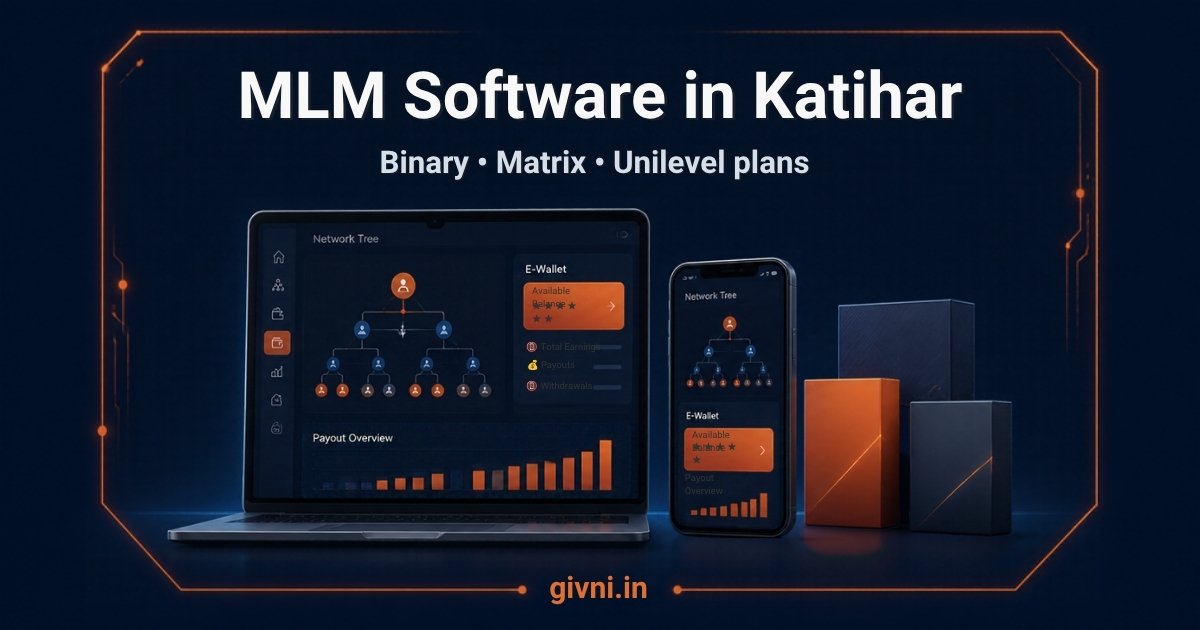
Katihar is an important railway junction in north-east Bihar, with trade linked to agriculture, jute and nearby markets. Business owners here who start product-based direct selling often prefer a unilevel plan because it is easy to explain. But simple on paper does not mean simple in code. Good MLM software in Katihar must apply levels, qualifications and adjustments consistently every month.
This article explains how unilevel calculations work inside software. All numbers are examples only and do not suggest any level of income. This guide is about legal, product-based direct selling.
Why This Topic Matters for Local Businesses
Across Bihar, a large number of people are self-employed, and many small manufacturers and traders in and around Katihar are looking for new ways to reach customers. Direct selling of genuine products can be one such channel, but only when it is run transparently. Distributors want to see exactly how their commission was calculated; customers want honest product information and an easy return option; and the business owner needs accurate records for the accountant and for any enquiry. Spreadsheets and ad-hoc tools struggle to deliver all of this once the network grows. Purpose-built software, set up carefully around a lawful plan, brings these pieces together in one place. This guide focuses on one important part of that picture, so you can plan it with confidence.
How a Unilevel Plan Is Structured
In a unilevel plan, everyone you personally sponsor is placed directly on your first level. There is no limit on how many people can be on level 1. Their sponsored members form level 2, and so on. The plan pays a percentage of product sales volume on a fixed number of levels.
The Calculation, Step by Step
- Collect qualifying volume. The software adds up BV from paid product orders in the period, for each distributor.
- Check qualification. Many plans require a minimum personal product purchase or retail sale in the month for a distributor to earn on their levels. Qualification rules should be modest and linked to genuine use or resale, not forced stock-loading.
- Walk up the levels. For each order, the software finds the upline on levels 1, 2, 3 and so on, and applies the percentage for each level.
- Apply compression if your plan uses it. If an upline member is not qualified, compression may skip them and pass the commission to the next qualified person. Whether you use compression should be stated in your plan.
- Apply returns, caps and TDS. Returned orders reverse their volume; then deductions are applied.
- Produce the breakup. Each distributor sees which orders and levels contributed to their commission.
A Simple Illustration (Example Only)
Example only: imagine a plan that pays 5% on level 1, 3% on level 2 and 2% on level 3, with a monthly personal purchase of 500 BV to qualify. A distributor buys 600 BV of products for personal use, so they qualify. In that month:
- Level 1 product sales: 8,000 BV x 5% = 400
- Level 2 product sales: 5,000 BV x 3% = 150
- Level 3 product sales: 2,000 BV x 2% = 40
Total before deductions: 590 units. If 300 BV on level 2 were returned during the cooling-off period, 9 units would be reversed. These figures exist only to show the arithmetic.
Reports to Expect from MLM Software in Katihar
- Level-wise volume and commission for each distributor
- Qualified and non-qualified lists for the month
- Compression log showing where commissions were passed up
- Returns and reversals by period
Plan Design Tips
Keep the number of levels and rules easy to explain. Publish the plan document in the distributor panel. Avoid monthly qualification amounts that push people to buy more than they need. Have the plan reviewed by a legal or CA professional before it is configured.
Staying on the Right Side of the Rules
This guide is about businesses that sell genuine products through direct selling. Indian direct selling is regulated by the Consumer Protection (Direct Selling) Rules, 2021, and pyramid schemes and money circulation schemes are banned, including by the Prize Chits and Money Circulation Schemes (Banning) Act, 1978. The software should support, not hide, good practice. At minimum, plan for:
- Genuine products and income tied to actual sales, with no joining-fee-only earnings.
- Transparent commission rules published to every distributor.
- Cooling-off and returns handled inside the system, with refunds recorded.
- KYC verification of identity and bank account.
- Grievance redressal that customers and distributors can actually reach.
- Proper books and GST invoicing for everything the business sells or pays.
Nothing here is legal advice. Before going live, please have a lawyer or chartered accountant review your plan and paperwork.
How Givni Can Help
Givni designs and builds direct-selling software, distributor apps, websites, CRM and billing tools from its offices in Patna (registered office, Khajpura), Kolkata (head office, New Town/Rajarhat) and Noida. For a business in Katihar, that means a team close enough to meet and plan with. Tell us about your products and plan via the contact form.
हिंदी में पढ़ें: कटिहार में MLM सॉफ्टवेयर: Unilevel प्लान कैसे गिना जाता है
कटिहार उत्तर-पूर्व बिहार का अहम रेलवे जंक्शन है, जहाँ का व्यापार खेती, जूट और आसपास के बाज़ारों से जुड़ा है। यहाँ प्रोडक्ट-आधारित डायरेक्ट सेलिंग शुरू करने वाले कई लोग unilevel प्लान पसंद करते हैं, क्योंकि इसे समझाना आसान है। लेकिन काग़ज़ पर आसान होने का मतलब यह नहीं कि सॉफ्टवेयर में भी आसान हो।
Unilevel में जिन्हें आप सीधे जोड़ते हैं, वे सब पहले लेवल पर आते हैं और उनकी संख्या की कोई सीमा नहीं होती। उनके जोड़े लोग दूसरे लेवल पर आते हैं। प्लान तय लेवल तक प्रोडक्ट बिक्री के BV पर प्रतिशत देता है।
सॉफ्टवेयर पहले हर डिस्ट्रीब्यूटर का भुगतान हुए ऑर्डर से बना BV जोड़ता है, फिर देखता है कि उसने महीने की क्वालिफ़िकेशन पूरी की या नहीं — यह शर्त छोटी और असली इस्तेमाल से जुड़ी होनी चाहिए, ज़बरदस्ती स्टॉक ख़रीदवाने वाली नहीं। फिर हर ऑर्डर के लिए ऊपर के लेवल ढूँढकर प्रतिशत लगाता है। अगर प्लान में compression है, तो अयोग्य सदस्य को छोड़कर कमीशन अगले योग्य व्यक्ति को जाता है। इसके बाद रिटर्न, कैप और TDS लगते हैं।
उदाहरण के लिए (सिर्फ़ उदाहरण): लेवल 1 पर 5%, लेवल 2 पर 3% और लेवल 3 पर 2% हो, और बिक्री क्रमशः 8,000, 5,000 और 2,000 BV हो, तो कुल 400 + 150 + 40 = 590 यूनिट बनते हैं। यह सिर्फ़ गणित समझाने के लिए है, किसी कमाई का अनुमान नहीं। प्लान को सरल रखें, पैनल में प्रकाशित करें और कॉन्फ़िगर करने से पहले किसी विशेषज्ञ से जँचवाएँ।
एक ज़रूरी बात: भारत में डायरेक्ट सेलिंग Consumer Protection (Direct Selling) Rules, 2021 के तहत आती है, और पिरामिड स्कीम व मनी सर्कुलेशन स्कीम पर Prize Chits and Money Circulation Schemes (Banning) Act, 1978 के तहत रोक है। यह गाइड सिर्फ़ कानूनी, प्रोडक्ट-आधारित बिज़नेस के बारे में है। असली प्रोडक्ट, साफ़ लिखा कमीशन प्लान, कूलिंग-ऑफ और रिटर्न पॉलिसी, KYC, शिकायत निवारण की व्यवस्था, और सही रिकॉर्ड व GST बिल — ये सब ज़रूरी हैं। हम किसी तरह की कमाई या रिटर्न की गारंटी नहीं देते। यह कानूनी सलाह नहीं है; अपना प्लान फाइनल करने से पहले किसी वकील या CA से सलाह ज़रूर लें।
कटिहार या आसपास के इलाके से बात करने के लिए +91 98359 42411 या +91 94304 55055 पर कॉल करें, या givniinfo@gmail.com पर ईमेल करें।
Frequently Asked Questions
Is a unilevel plan better than binary?
Neither is automatically better. Unilevel is often easier to explain, while binary has different balancing rules. Choose based on your products and margins, with professional advice.
What is compression in a unilevel plan?
Compression skips non-qualified uplines so the commission goes to the next qualified person. Whether it applies should be stated in your plan.
Can the number of levels be changed later?
Yes, plan settings can be updated with versioning so past payouts remain traceable to the rules in force at the time.
Are the numbers in the example real earnings?
No. They are an example only, to show how the calculation works.
Next step: email givniinfo@gmail.com or call +91 98359 42411 / +91 94304 55055. We will walk you through a demo and the questions to settle before development starts for your Katihar business.