
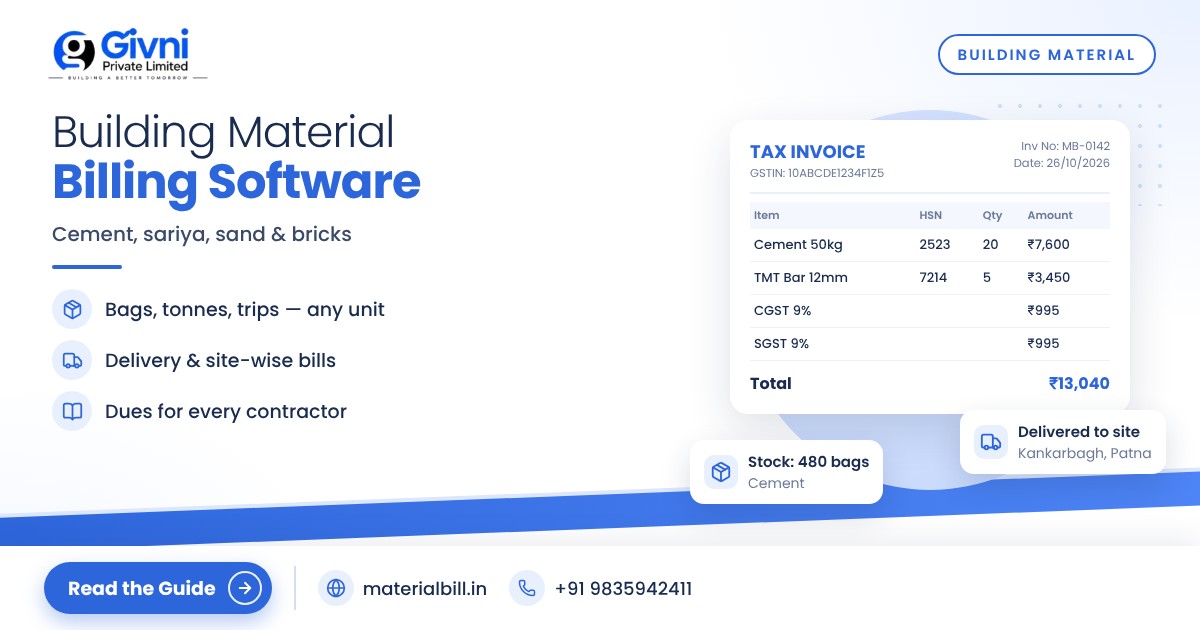
Walk into any building material shop in a Bihar town or on the edge of a growing city and you will see the same scene. A contractor is on the phone asking for 200 bags of cement at his site by evening, a truck driver is waiting for a slip, someone wants a rate for 2 tonnes of 12 mm sariya, and the owner is flipping through a register to check how much the mistri still owes from last month. Good building material billing software exists to bring order to exactly this kind of day: bills in bags, tonnes, brass and pieces, deliveries to different sites, contractor credit running for weeks, and GST that has to be right every single time.
This guide explains how billing works in this trade, what your bills must contain, and how to choose software that fits your dukaan.
Why billing is harder for building material dealers
A kirana store sells a packet of biscuits and the transaction is over. A building material dealer's sale is rarely that simple. A few reasons:
- Mixed units. Cement goes by the bag, TMT bars by weight (kg or tonne) and sometimes by piece, sand and stone chips by trolley, brass or cubic feet, bricks by the thousand. One bill can carry four different units.
- Rates change often. Steel prices can move every week. Cement companies revise dealer rates frequently. A printed rate list goes out of date quickly.
- Delivery to sites. Material is usually sent to a construction site, not handed over at the counter. The billing address (the contractor or house owner) and the delivery address (the site) are often different.
- Credit is the norm. Contractors take material through the month and pay when their own client pays them. Without a proper udhaar record, dues pile up and disputes start.
- Several GST rates on one bill. Different materials attract different GST rates, so one invoice can have lines taxed at 5% and 18%.
GST basics for cement, sariya, sand and bricks
After the GST rate changes that took effect on 22 September 2025, cement moved from 28% to 18%. Iron and steel products such as TMT bars are generally at 18%, and natural sand and stone aggregates are generally at 5%. Bricks have had special rules over the years (including an optional scheme for brick kilns), so check the current rate for the exact type of brick you sell. Always match the HSN code to the product, and confirm rates on gst.gov.in or with your CA before you set them in your software.
Some practical GST points that come up daily in this trade:
- CGST + SGST vs IGST. If the place of supply is in your own state, the tax splits into CGST and SGST. If you deliver to a site in another state, it is IGST. For site deliveries, the place of supply generally follows where the goods are delivered, so the site address matters.
- Buyer's GSTIN. Registered contractors and builders will want their GSTIN on the bill so they can claim input tax credit. A wrong GSTIN means a frustrated customer and corrections later.
- E-way bills. Truckloads of cement or steel often cross the value limit for an e-way bill. Keep invoice details accurate because the e-way bill is generated from them.
- Composition dealers cannot charge GST on their bills and must issue a bill of supply instead of a tax invoice.
What a building material invoice should contain
Here is a simple layout that works for most cement and steel dealers:
| Item | HSN | Qty | Unit | Rate (₹) | GST | Amount (₹) |
|---|---|---|---|---|---|---|
| OPC 53 grade cement | 2523 | 100 | Bag | 340 | 18% | 34,000 |
| TMT bar 12 mm | 7214 | 1.5 | Tonne | 55,000 | 18% | 82,500 |
| Coarse sand | 2505 | 2 | Trolley | 4,500 | 5% | 9,000 |
The rates above are only an illustration. Along with the item table, your bill should show:
- Your business name, address and GSTIN, plus a unique invoice number and date.
- Customer name, address and GSTIN (if registered).
- Delivery or site address and, if you like, vehicle number and driver name.
- Taxable value, CGST/SGST or IGST shown separately, and the total in figures and words.
- Previous balance and amount received, which helps contractors see their running account.
Handling weight, units and loading charges
Steel is where most counting mistakes happen. Many dealers sell sariya by weight but contractors think in pieces or bundles. Decide on one billing unit per product (usually kg or tonne for TMT) and write the piece count in the description if the customer wants it. Do the same for sand and aggregates: pick trolley, brass or cubic feet and stick to it.
Loading, unloading and transport (bhada) charges should be added as separate lines rather than buried inside the material rate. This keeps your margin visible and makes the bill easier for the customer to check. Ask your CA how transport charges should be taxed in your case, because the answer depends on how the supply is arranged.
Managing contractor credit without losing sleep
Credit sales keep this business running, but they also sink many dealers. A few habits help:
- One ledger per party. Every contractor, builder and house owner gets a separate account with all bills and payments in one place.
- Set a credit limit in your head (or on paper). Decide how much each contractor can owe before you ask for a payment.
- Send statements regularly. A weekly or fortnightly WhatsApp message with the outstanding balance prevents end-of-month arguments.
- Record part payments the same day. Cash and UPI received at the site by your driver must reach the ledger quickly.
- Follow up politely but consistently. Automated reminders take the awkwardness out of asking for money.
Checklist: choosing building material billing software
Before you pick any app or software, check whether it can:
- Create GST invoices with CGST/SGST/IGST calculated automatically, and bills of supply if you are a composition dealer.
- Handle different units for different products and multiple GST rates on one bill.
- Keep party-wise dues and send payment reminders.
- Track stock of cement bags, steel and other items, with alerts when stock runs low.
- Share bills on WhatsApp instantly, since most contractors live on WhatsApp.
- Give your CA a GST summary, HSN summary and GSTR-1 data without manual work.
- Work on your phone at the site and on a computer at the shop, with data backed up safely.
How MaterialBill helps building material dealers
The MaterialBill billing app is made by Givni Private Limited, a company based in Patna and Kolkata, and building material is one of the 70+ industries it is used in. It has dedicated pages for building material billing, cement shops and sariya and steel dealers. Here is what it does that is relevant to this trade:
- GST invoices with CGST, SGST and IGST worked out automatically, and bills of supply for composition dealers.
- Bills shared by WhatsApp, SMS, email or PDF, or printed on a thermal printer at the counter.
- Real-time stock with low-stock alerts and stock history, so you know how many bags are left before the next truck.
- Udhaar khata and dues tracking with payment reminders on WhatsApp and SMS.
- Daily and monthly sales reports, profit margin, GST summary and HSN summary, plus GSTR-1 JSON download for the GST portal.
- Cloud backup and sync across phone, tablet and PC through the browser, with offline mode and Hindi and English language options.
At the time of writing, the free plan allows 30 GST bills a month with udhaar khata and party management, and paid plans start at ₹249 a month. Busy dealers will likely need a paid plan for more invoices and staff logins.
FAQs
Can I bill cement in bags and steel in tonnes on the same invoice?
Yes. Each product line has its own unit, so one invoice can show cement in bags, TMT in tonnes or kg, and sand in trolleys. Set the unit once when you add the product and it will come up automatically while billing.
What GST rate applies to cement now?
Cement was moved from 28% to 18% in the GST rate changes effective 22 September 2025. Rates can change again, so confirm the current rate for your HSN code on gst.gov.in or with your CA.
How do I show the site address on a bill?
Keep the customer's billing details as usual and add the site or delivery address separately on the invoice. This matters for deciding the place of supply and for e-way bills when goods move by truck.
Is building material billing software useful for a small dealer?
Even a small dealer with a handful of contractors benefits from accurate GST bills and a clear udhaar ledger. A free plan is a low-risk way to start before you need more invoices.
Can my staff create bills from their own phones?
On MaterialBill, staff logins are available on paid plans (for example, 5 staff logins on the Standard plan at the time of writing), and data syncs across devices.
Conclusion
Cement, sariya, sand and bricks move in big quantities and on long credit, so a small billing mistake can cost real money. Clear units, correct GST, site-wise deliveries and a disciplined udhaar ledger make the difference between a busy shop and a profitable one. Start with the free MaterialBill plan, try it for a week of real bills, and call or WhatsApp +91 98359 42411 if you want help setting up your products.